

Sunscreen has officially moved from being a beach only product to an everyday skincare essential With rising awareness around premature aging hyperpigmentation skin cancer and even environmental damage people are finally paying attention to what they put on their skin. But as soon as you step into the sunscreen aisle or scroll through skincare content online you’re faced with one confusing debate mineral vs chemical sunscreen.
Both promise sun protection both come with passionate supporters and both are often misunderstood. One is praised for being clean and gentle while the other is loved for its invisible finish and lightweight feel. So what’s the real difference between mineral and chemical sunscreens and why does it actually matter for your skin health and lifestyle?
What Are Sunscreens And Why You Need Them:
Sunscreens are topical healthcare solutions used to shield the skin against UV radiation, which includes UVA and UVB rays that the sun naturally emits. Even with regular exposure through clouds or inside windows, UV radiation can cause both short-term and long-term harm to the skin despite not being apparent to the human eye.
Regular and unprotected exposure to UV rays can contribute to several skin concerns including:
Sunburn: An immediate reaction to excessive UVB exposure, resulting in redness, irritation, and discomfort.
Premature Aging: Long-term exposure can break down collagen and elastin, leading to fine lines, wrinkles, uneven skin tone, and loss of firmness.
Hyperpigmentation: UV exposure can trigger dark spots, melasma, and uneven pigmentation.
Skin Cancer Risk: Prolonged UV damage increases the risk of serious conditions such as melanoma, basal cell carcinoma, and squamous cell carcinoma.
Depending on the type of formulation sunscreens either absorb or reflect UV radiation before it reaches deeper into the skin. They are essential for preserving skin health and avoiding cumulative UV damage when worn properly and regularly. Regardless of the weather or degree of indoor or outdoor activity dermatologists advise using a broad spectrum sunscreen as part of a regular skincare regimen. Sunscreen should be used in conjunction with other sun safe behaviors such as donning protective clothes finding shade during the hottest parts of the day and donning accessories like hats and sunglasses for the best possible protection

How Mineral Sunscreens Work:
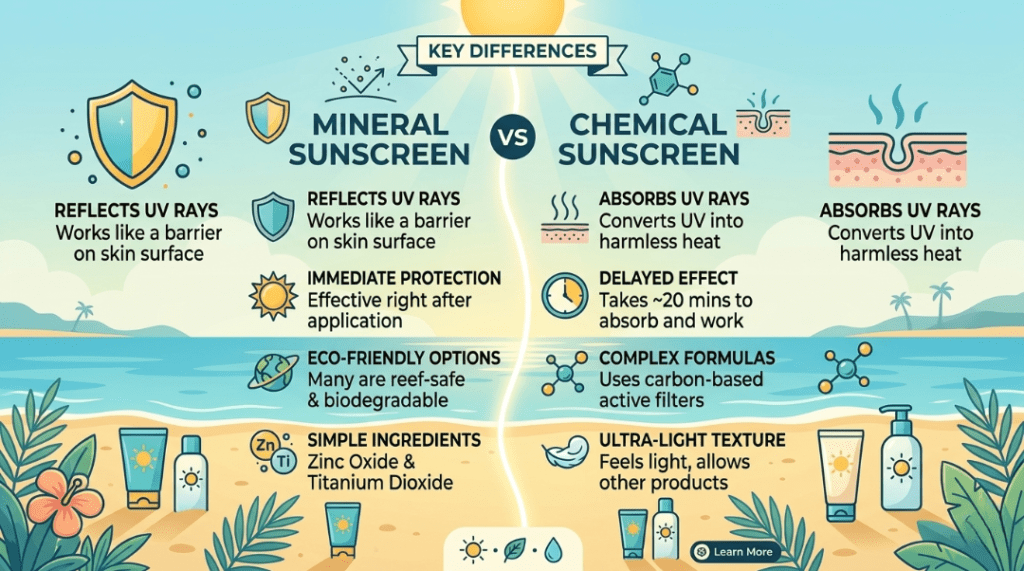
In order to provide a physical barrier against the sun mineral sunscreens create a protective layer on the skin’s surface. They have natural mineral filters that reflect and scatter dangerous UVA and UVB radiation away from the skin namely zinc oxide and titanium dioxide. Mineral compositions in contrast to other types of sunscreen stay on top to block radiation rather than absorbing into the skin. Additionally mineral sunscreens are less likely to degrade over time and are very stable in sunshine. They are frequently appropriate for delicate and reactive skin types because to their soft nature.
Key Ingredients:
- Zinc oxide provides broad spectrum protection against both UVA and UVB rays
- Titanium dioxide helps block UVB and short wave UVA rays
- Naturally derived mineral filters that remain on the skin’s surface
- Photostable ingredients that do not break down easily in sunlight
Benefits:
- Provides immediate sun protection after application
- Gentle and suitable for sensitive, acne prone and reactive skin
- Helps prevent sunburn premature aging and pigmentation
- Supports long-term skin health with consistent daily use
How Chemical Sunscreens Work:
Chemical sunscreens function by absorbing ultraviolet (UV) light and transforming it into heat, which the body subsequently releases. They have organic filters that block UVA and UVB radiation by penetrating the skin’s outermost layers. Chemical sunscreens should be administered 15 to 20 minutes before sun exposure because these compounds require time to activate after application. They blend effortlessly and don’t leave any noticeable residue thanks to their lightweight nature. Because of its transparent finish, chemical sunscreens are frequently chosen for daily use. They offer efficient broad-spectrum defense against sun damage when used properly.
Key Ingredients:
- Avobenzone: Provides strong protection against UVA rays that cause premature aging.
- Octinoxate: Helps absorb UVB rays and prevents sunburn.
- Octisalate: Boosts UVB protection and improves the formula’s stability.
- Homosalate: Enhances overall sunscreen performance and UV absorption.
- Oxybenzone (in some formulas): Offers broad spectrum protection but may not suit sensitive skin.
Benefits:
- Lightweight and invisible: Absorbs quickly into the skin without leaving a white cast.
- Comfortable for daily wear: Ideal for humid climates and long working hours.
- Makeup-friendly: Layers smoothly under foundation and other skincare products.
- Effective sun defense: Helps protect against sunburn, pigmentation, and premature aging.
- Wide variety of formulas: Available in gels, lotions, sprays, and water-resistant options.
Is Mineral Sunscreen Better Than Chemical Sunscreen:
The best choice ultimately depends on your skin type comfort and consistency of use rather than the formula itself. Mineral sunscreen is often preferred for sensitive or acne prone skin because it sits on the skin’s surface works instantly and is less likely to cause irritation. Chemical sunscreen is valued for its lightweight texture invisible finish, and ease of layering under makeup making it more suitable for daily cosmetic use. Chemical & Mineral Sunscreen both protect well when applied and reapplied correctly.
Comparison Between Mineral Sunscreen vs Chemical Sunscreen:
Learn about the differences between mineral and chemical sunscreen:
| Feature | Mineral Sunscreen | Chemical Sunscreen |
|---|---|---|
| How it works | Sits on skin and reflects UV rays | Absorbs UV rays and converts them into heat |
| Key ingredients | Zinc oxide, Titanium dioxide | Avobenzone, Octinoxate, Oxybenzone, Homosalate |
| Start of action | Works immediately after application | Needs 15–20 minutes before sun exposure |
| Skin feel | Can feel thicker or slightly heavier | Lightweight and invisible on skin |
| White cast | May leave white or gray tint | No white cast |
| Skin suitability | Best for sensitive or reactive skin | Best for normal to oily skin, makeup use |
| Irritation risk | Low | May cause irritation in sensitive skin |
| Finish | Natural but sometimes visible | Smooth, cosmetic-friendly finish |
| Water resistance | Available in some formulas | Widely available in water-resistant formulas |
Pros And Cons Of Chemical Sunscreen:
No sunscreen is flawless. Depending on how and where you intend to utilize it each type has trade offs.
Pros And Cons Of Mineral Sunscreen:
✔️ Pros
- Provides immediate protection after application
- Gentle and suitable for sensitive, acne-prone skin
- Uses zinc oxide and titanium dioxide for broad-spectrum coverage
- Less likely to cause irritation or allergic reactions
- Often considered reef-safe and environmentally friendly
- Helps protect against both UVA and UVB rays effectively
❌ Cons
- May leave a white or gray cast on the skin
- Can feel thicker or heavier compared to chemical sunscreen
- Sometimes harder to blend evenly
- May rub off more easily with sweat or friction
- Less invisible finish under makeup
- Can require more frequent reapplication for best protection
Pros and Cons Of Chemical Sunscreen:
✔️ Pros
- Lightweight and comfortable on the skin
- Blends easily with no white cast
- Works well under makeup and daily skincare
- Provides broad-spectrum UV protection
- Available in many textures like gels, lotions, and sprays
- Often more water- and sweat-resistant formulas
- Feels cosmetically elegant for everyday use
❌ Cons
- Needs 15–20 minutes to become effective after application
- May cause irritation for sensitive or acne-prone skin
- Some formulas can sting around the eyes
- Requires careful layering with other skincare products
- Certain ingredients may not suit very reactive skin types
- Can break down more easily with sun exposure compared to mineral filters
Which Sunscreen Type Suits Your Skin?
- Mineral sunscreen suits sensitive, reactive, acne-prone, or redness-prone skin because it is gentle and less likely to cause irritation.
- Chemical sunscreen is ideal for daily makeup wearers because it blends smoothly without leaving a white cast.
- Mineral sunscreen is ideal for post-treatment skin such as after facials, peels, or laser procedures.
- Chemical sunscreen works well in hot and humid climates due to its fast-absorbing texture.
- Mineral sunscreen works best for people who prefer natural, minimal-ingredient formulas and immediate sun protection.
- Mineral sunscreen is better for those who prioritize skin sensitivity and barrier protection.
- Chemical sunscreen is better for those who prioritize cosmetic elegance and comfort.
- Both mineral sunscreen and chemical sunscreen are effective when they are broad-spectrum SPF 30 or higher and applied correctly.
- The best choice ultimately depends on your skin type, lifestyle, and consistency of use.
Summary:
Although they both shield the skin from damaging UVA and UVB radiation, mineral and chemical sunscreens function entirely differently. Mineral sunscreen provides instant protection and a kinder alternative for skin that is sensitive or reactive by physically blocking or reflecting UV radiation using zinc oxide and titanium dioxide. Chemical sunscreen, on the other hand, uses substances like avobenzone and octinoxate that penetrate into the skin and turn UV radiation into heat. Sunscreen selection is crucial for skin health and long-term protection against sun damage, premature aging, and other issues. Both types are effective when worn properly, but the best option depends on skin type, comfort, and lifestyle needs.
FAQs:
Q1: Which is better: mineral or chemical sunscreen?
A: Neither is universally better. Mineral sunscreen is better for sensitive skin, while chemical sunscreen is preferred for a lightweight, invisible finish.
Q2: Is mineral sunscreen safer than chemical sunscreen?
A: Mineral sunscreen is generally considered gentler and less irritating, but both types are safe and effective when properly formulated and used.
Q3: Why does mineral sunscreen leave a white cast?
A: The physical UV filters (zinc oxide and titanium dioxide) sit on top of the skin and can reflect light, sometimes creating a visible white or gray tint.
Q4: Can I use sunscreen every day?
A: Yes, daily use is highly recommended because UV rays are present even on cloudy days and indoors near windows.
Q5: Which sunscreen is best for oily skin?
A: Chemical sunscreens are often preferred for oily skin because they feel lighter and absorb quickly without a heavy finish.
Read More Aricles https://trendythreads.net/daily-spf-habits-for-healthy-and-glowing-skin/


